Tuesday, 27 October 2020

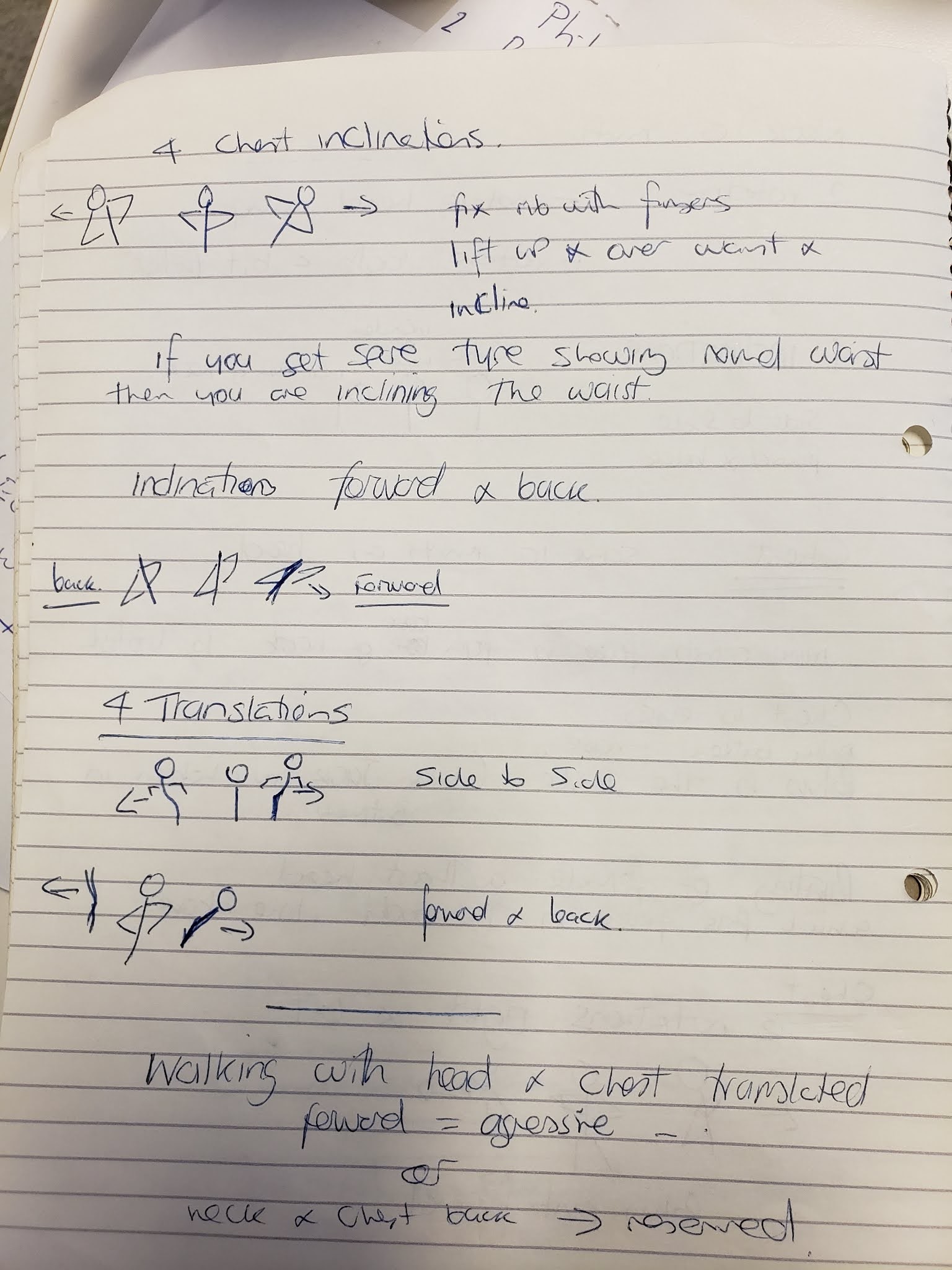
10 Movements of the Chest

A Mime Artist's face stretches from the base of the neck to the crotch. The chest is his/her eyes, i.e. belly button is the nose and the pelvis is the smile. 

2 Chest Rotations right and left 


4 Chest Inclinations - see below (Fix rib with fingers and lift up & over waist and incline.) If you get a spare tyre appearing around the waist, you are inclining the waist not the chest. 

5.  Chest Translations - see below


As an exercise:

Explore moving the chest through it's different plains and thinking how it makes you feel.

Work with a partner to explore this further and even add a dialogue to your movements

Walk around and put an emotion or motivation on the movement. For example, walking with chest (and head) translated forward = Aggressive. Walking with head and neck translated back = reserved.

In a group of 2 to 4 people create a short scene using the chest. Each person could assume a different chest  position and play the character accordingly. Or create a short scene where all 10 chest positions are visible and used. 

Monday, 19 October 2020

Guardian Angel (Physical Leg Twist phrase)

 The Guardian Angel is an exercise that requires leg strength and balance. It is performed slowly and with control. See diagram and instructions below:

Part 1

1. Stand facing forward with legs about 1 meter apart.

2. Pivot front foot. Back foot stays in same position

3. Lift back leg up and point toe

4. Rise up onto toe, with front leg taking weight

5. Bring together and gently lower to floor

6. Take weight on front leg. Feel back with pointed toe.


Finish

7. Turn body front & on toes

8. Then gently lower down into starting position

Tasks

1. On your own Practice the "Guardian Angel" whilst reciting a poem or familiar text like a prayer of nursery rhyme. 

2. Join with a partner or get into a three and perform a piece together. As you move think of spacing, design, use of Canon and Question and answer.

3. In your group you might also choose some music.

4. Dramatic Scene: - In a small group create a short scene using the Guardian Angel


Friday, 16 October 2020

10 Movements of the Head

As you practice these moves concentrate on performing the technique well (See diagram below)

Start by standing straight in a neutral position. Shoulders relaxed and feet should width apart.

1. Rotation - Rotate (Turn)  head to look left then right

2. Inclination - Tip head to the side, left and right, Tip head forward and back


3. Translation - Head shifts along shoulder left and right, Head moves forward and back like a funky chicken.


Tasks:

a. When you look, think about what you might be looking at? i.e. Why are you looking up, down, right-side etc.

b. Think about any emotions connected to the head movement, i.e. Shock, surprise, interest, 

c. On your own devise a solo using all the head movements.

d. With a partner create a scenario where the head movement is put into a real life situation. i.e. Teacher asks pupils question and pupils head  tilts to the side 

Or

Give out some scenarios to each pair, which they perform using all the head movements.

i.e. Job interview, romantic dinner, boxing match, Tennis game, 

What else would Jesus Do? (Boal in the Bible)

Warm up games
Knee Tag
Sword fighting
Treading on toes
Force field

Activity
1. Split into groups of 4 or 5
2. Read through the gospel text together
3. List encounters where Jesus intervened in a situation, For example:
Women caught in adultery
Martha and Mary
Zacheus in a tree

4. In your group create images of each intervention in the story (which can be shown to the other groups)

5. Pick one story and create images for what actually happened before and after the intervention.
Explore through images other scenarios before and after (What else could Jesus have done?)

6. Pick a scenario you like and explore adding movement and speech to each image.

7. Perform to the other groups and Discuss 

8. Replay and  invite people to intervene with alternative scenarios.

Tuesday, 15 January 2013

Creating stories (Tribes)

Ask the group to brainstorm what they understand by a tribe and write them on a big peice of paper.
In groups of 4 or 5 ask the group to create their own tribe asking the following questions.

1. What is your name?
2. What is your symbol? (draw and colour in if necessary)
3. What is your main value in life? (put in the form of a motto)
4. What types of clothers do you wear?
5. Where do you live?
6. What is your initiation ceremony to get into the tribe?

If the group want to add other details then they can. Feed back to one another about your tribes.

Story tasks:
Get each group to create a story about how their tribe came into existance. Get the group to present it back by acting it out.
Join two groups together to make a story which involves both of their tribes. Get them to feed back by retelling it and acting it out.

Sunday, 25 November 2012

Creating scenes from characters

Here are 3 easy steps to create a drama from exploring characters

1. Create a character:  (Or you could choose an exisiting charater)
- Write 10 questions to yourself to get an initial idea of who you are? How old are you?, Where do you live? Do you have family? What is your favourite colour?
- Hot seat one another to find out more about each other and yourself. If you discover more about yourself in this exercise jot it down

2. Write a monologue - More about who you are. What you like/dislike. Tell a memory from your childhood and one from a recent event.

3. Create Scenes: Put the characters together in a scene. Choose a context for where you are i.e. A parents evening, outside a burning house, at a party. Think also about character traits and each character's history to make links to one another.

Friday, 23 July 2010

Apple Pie

One person stands facing the wall away from the rest of the group.

Someone is picked to say "Apple Pie" out loud in a voice different to their own.

The person standing facing the wall turns round and tries to guess who said "Apple Pie"

If they do not guess correctly then the process is repeated with someone else from the group is chosen to say the word.

Progression:
This is an excellent exercise to create different voices, experimenting with voice tone and quality. It can also be used to find different characters and could be used to create a short scene. For example 3 voice types could be selected and Incorporated into a scenario. The type of voice can give clues to the persons character or even a particular scenario. A brainstorming exercise might be a good tool to explore this.

Friday, 16 July 2010

Three taster sessions to build a Youth Theatre (Green Shoes Arts)

Session 1: Aim - To give young people the experience of working together and being able to focus in drama.

Warm up games:
Presenting: Form a circle and in turn each person walks into the middle and says their name and something interesting about themselves.

Budge: Click on link here

Focus Warm up: Click on the "walking as a group" link here - Also you can use a variation of commands: Stop, Go, Jump and duck. The group must respond by first doing the commands they hear and  then by doing the opposite i.e. Jump when they hear duck or stop when they hear go. Progress by getting the group to say the opposite command before they do it.

Create a scene from an image playing Grandmothers Footsteps. Choose 3 images and illicit from the group what they see. What story? Who are the characters? The task is to create a story in pairs using these 3 images.

Create a scene representing the local area
Brainstorm on Dagenham Heath (your locality) 1. Adjectives that describe it, 2. Places, 3. What can you do there?
Pick a word from each list randomly and create a scene using those 3 words i.e. Windy, Swimming pool, Reading.

Session 2: Aim - To create stories through improvisation

Warm up activities: Passing a clap around the circle, Passing an imaginary ball around the circle under your feet, Throwing a tennis ball in the circle,

Create images in groups: Walk around the room and on the command 2.3.4.5's etc get into groups. When you hear an image called out in your group create that image without talking.
Progress by creating a big group image. For example a Kitchen or a hurricane.

Story telling exercise: In a circle tell a story around the circle with each person adding a sentence. One person act a s a scribe to get the main points of the story recorded on paper.

Physical story-telling: In a group narrate and physicalise the story the group has created.

The improvisation Party exercise: Everybody must act that they are at a party, talking, pretending to drink, eat food, dancing. The door bell will go and someone will enter the room acting like a particular character they have been given, i.e. Superman, an alien etc. The guests must carry on improvising and interact with the new guest. The aim is for the party guests to guess who the characters are.

In the style of... Give the group the scenario of buying something in a shop in the style of different theatrical genres. e.g. Eastender's, a cartoon, Opera, Bollywood, Melodrama, etc

Session 3: aim - Create characters using props

Warm up games: Come into the middle of the circle and say your name and what it means. You can make it up and the rest of the group have to guess if it is true or false. Variation - No one can say umm! or make a noise before a name or they are out.

Characteristics brainstorm: Create as many words that describe people i.e. angry, happy, devious. Put a range of hats and props in the middle of the room and a hat of random ages to pick out from. Each person is given a prop and picks out of the hat a characteristic and age.

Character improvisation: Walk around the space thinking about who your character is. How do they walk, hold their body, how fast, slow, heavy or light. Stop! How do they stand? Where is the weight? Head position?

Progression: By putting the character into different scenarios. Waiting for a bus, Sitting on a bus, At the cinema, buying a ticket? In a argument with the cashier etc.

Big Group feed back: Share things you observed about the characters you were or observed. How did it make you feel? How was it difficult? What were you thinking?

Perform a scene in character: In three's perform a scene as your character In a context of your choice

A Star and a wish - Feedback with a star - something you liked about the scene and a wish - something you would like to see done differently.

Create a scene from a game: In three's chose a game and plan a session where you create a scene from playing the game. i.e. apple pie

Tuesday, 14 April 2009

Building Narratives with shapes

Purpose of the Activity

This activity helps learners explore imagination, storytelling, teamwork, and physical improvisation by using simple shapes as the starting point for creating scenes and narratives.

Materials Needed

- A set of basic shapes (paper cut-outs, cards, or objects) such as circles, squares, triangles, rectangles, stars, and ovals.

Step-by-Step Instructions

·       1. Form a Circle: Have the group stand or sit in a circle so everyone can see the shapes clearly.

·       2. Introduce the Shapes: Place the shapes in the center and explain that each shape can represent anything in a story.

·       3. Choose a Shape: Invite one participant to pick a shape and describe what it could become.

·       4. Build the Narrative: Go around the circle, with each person adding a new detail to the story.

·       5. Add Movement (In small groups): Ask participants to act out what the shape represents using gestures or simple movements.

·       6. Introduce More Shapes: Add additional shapes to bring new characters, objects, or twists to the story.

·       7. Wrap Up the Story: Guide the group to bring the narrative to a natural conclusion and perform their story to one another.

Reflection Questions

·       How did the shapes influence your ideas?

·       What surprised you in the story?

·       How did working as a group change the narrative?

·       What did you enjoy most about the process?

Learning Outcomes

Participants will practice creative thinking, collaboration, improvisation, story structure, and communication skills.


Elasticity

Find a partner and face one another
Move around anywhere in the room but keep eye contact with each other
when leader shouts "change" you must change partner
Experiment with levels, distance, pace etc

Comment: This requires a certain amount of trust in the group to be able to maintain eye contact but is a good way of finding out the groups closeness.
This is a good spacial awareness exercise working with a partner and being aware of those around at the same time.

Knee tag

Find a partner and face one another
The idea is to try and touch your partners knee 3 times before they touch yours 3 times.
You can increase the difficulty by making each pair put an arm behind their back.
On the command "Change" You must find a new partner to do combat with.

Comments: Great to use with a new group especially as a way to get to know one another. This is also a good spacial awareness exercise as individuals are not just to watch their partners moves but be aware of those around them.

Mexican wave

In a circle one person sends a clap around the circle
Try to get the gap between claps as small as is possible.
First send it clockwise and then anticlockwise.
If you create 2 circles you can race to see which circle is faster.
Encourage people to be alert both with their eyes, ears and body.
You can make the circle tighter to increase the speed of the clap.

Comments: This is a fun one to use with a new group to introduce the idea of play and team work. It is good to use with a group who may be a little nervous about doing drama to loosen them up.

Wednesday, 25 March 2009

Aadu veedu (goat House)

The game starts with everybody creating a Goat House (two people stand holding arms up to create a house and someone sits down underneath to represent the goat).
If the leader shouts "Goat" all the goats have to change place.
If the leader shouts "House" all the houses change places to shelter different goats.
If the leader shouts “Goat House”, then everyone has to change and recreate Goat Houses with different people.
At the start make sure there are a few free goats, so that they have to compete with the rest when they change.

Nb: Aadu Veeda is the Tamil name version of this game. It simply means Goat House. In the UK this game is more commonly known as house, person, tempest

Variation
You can add to the analogy of house by saying "extension" Two people then have to create an extension each side.

Comment. I have used this game with a group that did not know each other well and it worked very well. I think because it is well structured and the children knew exactly whatt was expected of them. However it does encourage mingling as well

Monday, 16 March 2009

Conducting game

Divide the group into twos and instruct them to create a short sound or rhythm that they will be asked to share with the group.
Everyone shares their sound.
Explain to the group that you as the leader will be a conductor and as you point to a pair they must make their sound/rhythm until you point to them to stop.
As conductor you can bring anyone one in you want at any Time so everybody must be watching and ready.
The conductor also shows the group other signs such as increase or decrease volume using his hands. (or lengthen or shorten sound)
The challenge is for the conductor to create as rhythmical a sound as possible.
When the conductor has had enough he can pass the baton to whoever he wants and he then joins that pair.

Variation:
This can also be done with simple movement to create a dance piece
A outside pair of eyes can watch the action and look for narratives ion the movements. This can be fed back to the pairs and a scene could be devised out of this.
Shapes/movements/narratives can be paired off together to create something

Friday, 27 February 2009

Red shoes

Make a circle sitting on chairs
One person stands in the middle and must say something about themselves.
i.e. "I am wearing red shoes."
Everyone with red shoes must change places without letting the person in the middle sit down.
The person who cannot sit down then becomes the person in the middle.
And so on.

Variation
A condition can be put on the game like, Only share something that happened to you last week, or tell the group something you dislike.
If there is no condition put on the game it is interesting to see how much people disclose about themselves and cit an give you a good indication of the level trust within the group.

Comment: I found this a useful game when working with excluded pupils recently to guage how far they were willing to open up. I also repeated it at the end of the term to see how far they had come.

Wednesday, 18 February 2009

Ali Ali Ali !

Group stand in a circle with one person in the middle.
The person in the middle must say someones name three times before they can say their name once.
If the person in the middle succeeds then they join the circle.
The person on the outside who failed then goes into the middle.

Comment: A good game when the group is familiar at least a little bit with eachothers names. However the person in the middle can always ask people in the circle their names to remind themselves. This also builds up tension as that person ios then expecting their name to be said

Wednesday, 11 February 2009

Playback Theatre 2

Retell in a group of 3 how you came to school/work this morning
Other members of the group listen and hold on to 3 images that come out of retelling.
Create 3 images for each persons story in the group
Each group of 3 should have a total of 9 images to show.
Create a stage with a chair to one side where the person who told the story sits.
His/her partners present the 3 images that represent their story, but the author in the chair cannot speak.
You can ask the audience to comment on what they saw or even suggest ideas as to what they think happened.
Each group of 3 takes it in turns to get up and perform their stories and images
Music can be used as an accompaniment to the stories

Variation
The author retells their story out loud to the audience and the partners perform the 3 images at the appropriate time in the story
The author is not allowed to make any additional comments.

Comment: I found this exercise quite moving especially where quite personal stories were shared. It is as if the story tellers story is being valued by the others acting it out and they could show something that the person might want shared but find it too hard to speak about. I was recently doing a project in Manilla with Street Children where we talked about using this exercise to tell some of their stories. Unfortunately it didn't happen but I will keep it up my sleeve for another time.

Tuesday, 10 February 2009

Alphabet

In groups of 3 make a letter of the alphabet.
Show them to one another and try to guess them.
Choose one group of 3 in turn and the rest of the group brainstorm out loud any words, shapes images or stories they see.
Each group create a short scene using the ideas given with their shape as a component of it.

Variation
You can join groups (shapes) together to create a short scene where they either go together or offer a contrast.

Comment: I did this recently in a school with primary children and it worked a treat. It is something that they had a lot of fun doing without having to think too much, but it opened up a whole load of ideas when they started to look at one anothers shapes.

Friday, 6 February 2009

Football clapping tribes

Clap out the rhythm "dada, dadada, dadadada, dada."
Split into two groups and set first group off clapping once through
Then bring in the second group after the first "dada".
While the groups are still clapping give them instructions.
i.e. cross over, walk around the room, sit down etc

You can also split the main group up into smaller groups (tribes) and set them off clapping at different times.
Stand in a circle and call each tribe into the middle to perform their clap.
The leader can act as a conductor raising of lowering the noise level and stopping or bringing different groups in.

Comment: A cracker of an exercise so long as the leader has the rhythm and timing to bring everyone in. I did this with Ali Campbell at Goldsmiths and you literally can lose sense of time and get lost in the rhythm. It is also interesting to seee how you start to relate to each other through facial expresiion and body gesture.

Monday, 13 October 2008

Sparkle

Stand in a circle and get the group to rub their hands together
Then instruct them to rub different body parts
Ask the group if they can start to feel their hands or finger tips tingling
The idea is to focus this energy into a clap around the circle
As the clap comes to you simply send it on round the circle with as much energy and focus as possible
Give the instruction that the clap can be reversed around the circle
Also the clap can be sent across the circle.

Variations:
Try and play this game with your eyes closed, with the idea to not catch anyone out but rather keep the clap going.
(You will need a pair of eyes open to act as adjudicator)